Showing posts with label arts308. Show all posts
Showing posts with label arts308. Show all posts
Saturday, May 9, 2015

Monday, May 4, 2015
ARTS 308 - Kinetic Sculpture Post-Mortem

Last Thursday I gave my presentation for Topple, my kinetic sculpture and final project for ARTS 308. I feel that the presentation was a success and that general audience reaction was positive.
Finished Construction

The final touches to the sculpture were completed on-schedule; some adjustments were necessary to make the wind-up/release mechanism smoother and I also added spacers to the base of the sculpture.

Above is a close-up of the winding mechanism. While I had the option of creating a metal pulley system, I chose to make it wood to stay on-theme with the rest of the sculpture.

The locking for the mechanism is rudimentary yet effective; you simply stop the wind-up hook with the block and remove the block to release the mechanism. Again, this component is on-theme with the rest of the sculpture and I was satisfied with that despite its crudeness.
Topple is a kinetic sculpture that experiments with the natural force of gravity and the possibility of both constructive and destructive movement. It was inspired by childhood play activities which are inclusive of both creation and destruction. I started with the desire to portray de-constructive motion and built off of the idea of children being just as excited to destroy structures made from toy blocks as they were to create them.
The motion of Topple is achieved by using a winding mechanism to "build" a tower of toy blocks, and releasing the mechanism to make the tower fall down. Due to the connected structure of the blocks, the process of building and destroying the tower can be repeated again and again.
The experimental kinetic element is derived from the falling motion of the "tower"; the blocks never topple over each other in the same way twice.
Nostalgia for childhood play experience is a major theme of Topple. As a small child, I played with wooden toys. The main structure of the sculpture is wooden, as well as the winding mechanism. I wanted every detail of the sculpture to support this overall theme of nostalgia. The blocks themselves were hand-cut, sanded, and hand-painted by me. The color scheme of the blocks incorporates the three Primary Colors - a direct reference to early childhood. The process of building Topple was a singular experience for me because I had never built anything like the old wooden toys of my childhood as an adult. I feel like the experience of playing with wooden toys is going extinct; indeed, I see more small children playing with electronic hand-held media more than anything else.
Hopefully Topple will evoke the memories of innocent childhood play in viewers and will prove an edifying and interesting interactive experience.
As Topple is interactive and hand-powered, the best place to exhibit it could be any public space (hopefully sheltered from weathering).
Reaction

Reaction to Topple seemed positive; the mechanism for winding/letting fall the "tower" of blocks was easy enough for viewers to manipulate themselves.
Many viewers commented on its resemblance to early childhood toys. They also commented on the nostalgic design.
Final Thoughts
If I could redo this project I would have spent more time perfecting the structure of the block "tower". I would have experimented with more interesting structures for the "tower" and engineered structures that held up better.
The twine used to make the "tower" is appealing but it won't last forever. Eventually it will wear out and snap. There was also an issue of the twine stretching after winding the "tower" up. The winding mechanism itself is very simple and I might have spent a little more time perfecting its design, although in its current state it certainly gets the job done.
Topple was the first time I've built something resembling the wooden toys of my childhood; I enjoyed working with my hands to achieve a sturdy structure that could house the main action of the sculpture. I was very pleased with my work painting the toy blocks. In some ways I felt like an old-time toy maker.
Tuesday, April 28, 2015
ARTS 308 - Kinetic Sculpture Progress #3

As of yesterday the "tower" of blocks is complete. The blocks seem to fall with good spacing and yet they still resemble a "tower" structure.

Cylindrical wooden dowels didn't provide the structural support I needed so I switched to furniture balusters which are much thicker. In the above photo you can see the beginnings of the pulley system that winds up the blocks into their "tower" form.


The above photos show that the wind-up pulley works and, once let go, it allows the blocks to fall in a smooth manner.
After getting instructor feedback, I'll be putting the final touches on the sculpture in preparation for Thursday's presentation.
Monday, April 27, 2015
ARTS 308 - Kinetic Sculpture Progress #2

As of Saturday the wooden toy blocks have had holes drilled in them and are connected by twine to form a "tower" network. The tower will probably be about two feet high. The remaining steps are forming a wooden structure to house the blocks and a winding spool mechanism to raise and drop the "tower".
Thursday, April 23, 2015
ARTS 308 - Kinetic Sculpture Progress

Fifteen wooden blocks have been cut, sanded, and are being painted for the kinetic sculpture. After they dry I will drill holes through them so that the twine can run through and create a "tower" network of children's blocks.
ARTS 308 - Project 3 Re-Proposal
As of last week I've finally settled on my final kinetic sculpture idea.
Concept
This kinetic sculpture explores childhood memories of building blocks - and how it was just as fun to destroy my creations as it was to build them.


Tuesday, March 31, 2015
ARTS 308 - Kinetic Sculpture Proposal
Moving Shadow Attached to Performer

Exploring the social (macro) and emotional (micro) implications of identity as represented by our shadows.
A performer manipulates a lightweight armature that is attached to their feet and hands.
Materials
I want to use something lightweight that will not be too cumbersome for the performer (balsa wood, fabricated plastic sheets). I also want to design a structural joint system that is flexible but won't collapse under gravity. Finally, I'm interested in creating a structure that fits together rather than relying on hardware to attach the different parts of the armature.
Challenges
- Designing a structure that "fits together" without much hardware
- Finding light yet sturdy material
- Figuring out the balance of the sculpture as attached to the performer
Monday, March 30, 2015
ARTS 308 - Inspiring Kinetic Sculptures
About Face - Anthony Howe
88" h x 62" w x 60" d
Copper, stainless steel


The sculpture is powered by a person pedaling the mechanism. It represents how energy is generated, transmitted, stored, and released in a sustainable environment.
This sculpture is an extreme example of human-powered sculpture, a concept I find inspring.
88" h x 62" w x 60" d
Copper, stainless steel
About Face uses wind power to articulate copper panels that make up a face.
About Face is interesting to me because it brings a human element to Anthony Howe's otherwise non-human kinetic sculptures. The individual panels making up the face remind me of pixels in a digital image, only these pixels are manipulated in 3D space in the real world. Some of the panels are driven by a mechanism, while others are "free-swinging", according to Howe. This piece makes me think of the ever-changing collective identity of the human race. Each panel could represent a human life, with its own directions, articulations, and driving forces. The panels collectively form a composite representation of the human landscape.
Kinetic Ball Sculpture Energy - Hüttinger
The sculpture is powered by a person pedaling the mechanism. It represents how energy is generated, transmitted, stored, and released in a sustainable environment.
This sculpture is an extreme example of human-powered sculpture, a concept I find inspring.
Thursday, March 26, 2015
ARTS 308 - Kinetic Sculpture Introduction
Man-Made Kinetic Movement
After viewing James Cody Hovland's kinetic ship sculpture, I realized that wind-driven sailing ships are just big wind-powered buoyant sculptures, and that the same principles behind moving sailing ships are used for wind-powered artistic sculptures.
Hovland's kinetic ship sculpture explores beyond simple wind propulsion and transforms the entire hull of the model ship into a mechanical entity with a life of its own. Curiously, the hull of the ship seems to drive the movement of the sails at times.
Natural Kinetic Movement
Snakes almost seem like a kinetic sculpture themselves - they move with a rhythm not found in most animals. After doing a little research I learned that snakes propel themselves on their scales which are designed to slide the snake forward while catching on the ground as they move side-to-side. So, in terms of Visualization, the snake is made up of a hierarchy of joints that rotate on an axis while translating eachother forward. The movement is re-created in wooden toys that you see at places like Hobby Lobby. The concept of connected joints like a snake's skeleton could be an interesting way to create a kinetic sculpture.
And just for fun:
Wednesday, March 18, 2015
ARTS 308 - Body Extension Sculpture Post Mortem

Last Thursday I exhibited my body extension sculpture to the public. Besides my peers in class, a few children from a social program and some video cameramen came to try out our sculptures.
Sculpture Presentation
I was inspired to make this sculpture from an idea I had about having an extendable hood that let you use your phone in dark places like a movie theater (and also from my wife frequently telling me to put my phone down and pay attention). I thought about how technology controls our attention while tempting us with mass connectivity. It's as if portable technology has attached itself permanently to us, and immediate person-to-person interaction is becoming extinct.
One of the biggest design challenges was shape language and communicating the austerity of technology as it fuses with the organic self. Using foam board, I crafted a box which represents the universally rectangular shapes our portable technologies come in. The wires, representing physical electric connection and also "mass connectivity" offered by the World Wide Web and social media, are uniform as they leave the box. As they travel towards the viewer, the shape language of the wires become more organic. They spread, twist, curve, and interweave in a synthetic network of vessels and veins. The cloth around the mask section runs along the naturally organic curve of the viewer's face.
The all-black design accomplished my goal of creating a sculpture entity that was oppressive and cold. The sight of the wire network attaching itself to the viewer's face brings to mind images from cyberpunk visionaries such as H.R. Giger. To me, the sculpture became a symbol of our present relationship with portable technology but also a model for a possible physical relationship with technology in the future. My choice of materials was critical in creating such a symbol.
Application
I would display this piece in a public gallery and have it either performed by someone or permanently attached to the face of something like a mannequin. There was still the option, however, of inserting one's iPhone into the box and viewing, with absolute focus of attention, our own portable technology. I would have liked to have developed ways for viewers to put on the sculpture with an iPhone inserted, assuming viewers wouldn't destroy my sculpture in the process.
Reaction
From what I could tell, the overall reaction towards my sculpture was curiosity as it stood alone. The curiosity turned to repulsion at the sight of the sculpture's parasitic relationship with the viewer/performer - most agreed that it was "creepy". I feel that this reaction reinforced the purpose of the sculpture and that my design and material choices contributed to the reaction.
The children who visited the class didn't seem to understand the sculpture, although they were curiously less afraid of it. I'll admit, I felt apprehensive showing them such a negative sculpture.
Looking Back
If I could do this sculpture over again, I may have crafted a longer tunnel of wires connecting the box to the viewer's mask. With budget constraints, I could only afford to make the tunnel/tube about 18 inches long. Perhaps I could have developed a way to attach the box to a wall and have the viewer walk up to it and peer through the mask.
These limitations did not ruin the project, however. I thought the need for the performer to hold the box in their hands reinforced the image of portable technology that demands not only to absorb our attention and focus, but also to occupy our hands.
The foam board box is rudimentary and I could have spent more time and care making a more sleek-looking box.
Monday, March 16, 2015
ARTS 308 - Body Extension Sculpture Process
The Box
One end of the sculpture had to represent technology, so I chose rectangular, austere shape language that is evident in most of our popular electronics. I originally wanted to make the main color of the sculpture white to mimic the color of Apple products but I eventually chose black to represent a kind of anti-Apple.
You can see in the photos below that I used black foam core and left an indention to insert my iPhone 4.


Black foam core proved very difficult to hot-glue together into a hollow box after cutting pieces. I ended up having to reinforce the box structure with tape so it would hold together. If I had given myself more time to experiment with this technique I might have fabricated this piece with a 3D printer.
Tube of Wires
I measured the perimeter of the inside of the box against the perimeter of a plastic mask from Hobby Lobby (I ended up not using the mask but I used its perimeter as a template for later). The box perimeter was about 26" and the mask measured 27" around my face, so I cut a black fabric section that was 26" on one end, 27" on the other, and ran 18". Now I had enough fabric to fit inside the perimeter of the box while being able to fit around the mask part.
Using a 50-foot roll of 16/2 electrical wire, I cut pieces and hot-glued them to the black fabric. I split the wires and arranged them into a more organic pattern, like blood vessels, at the mask end. This process was the most time-consuming.
Finishing Touches


One end of the sculpture had to represent technology, so I chose rectangular, austere shape language that is evident in most of our popular electronics. I originally wanted to make the main color of the sculpture white to mimic the color of Apple products but I eventually chose black to represent a kind of anti-Apple.
You can see in the photos below that I used black foam core and left an indention to insert my iPhone 4.
Black foam core proved very difficult to hot-glue together into a hollow box after cutting pieces. I ended up having to reinforce the box structure with tape so it would hold together. If I had given myself more time to experiment with this technique I might have fabricated this piece with a 3D printer.
Tube of Wires
I measured the perimeter of the inside of the box against the perimeter of a plastic mask from Hobby Lobby (I ended up not using the mask but I used its perimeter as a template for later). The box perimeter was about 26" and the mask measured 27" around my face, so I cut a black fabric section that was 26" on one end, 27" on the other, and ran 18". Now I had enough fabric to fit inside the perimeter of the box while being able to fit around the mask part.
Using a 50-foot roll of 16/2 electrical wire, I cut pieces and hot-glued them to the black fabric. I split the wires and arranged them into a more organic pattern, like blood vessels, at the mask end. This process was the most time-consuming.
Finishing Touches
I glued the fabric into a tube and then glued it into the inside perimeter of the box as seen above. I got the exact shape language I had envisioned: a uniform, rhythmic composition of wires starting at the box and spreading, splitting, and turning more organic near where one's face would go. The hot glue left a lot of little plastic strings which had to be removed.
I folded the other end of the fabric into itself over a 27" strip of thick plastic and attached an elastic string to form a wearable mask.
Sunday, March 15, 2015


Tuesday, February 24, 2015
ARTS 308 - Body Extension Sculpture Concept
Concept
Technology, particularly mobile hand-held technology, offers a compelling distraction from the world around us. My body-extension sculpture is a mask that amplifies the distracting quality of technology. The mask fits on one's face and connects to a long tube structure attached to a fixture. Inside the fixture is an iPhone, iPad, or similar device.
The mask obscures the peripheral vision of the wearer, and the hand-held device is the only object that can be focused on. The flexibility of the tube demands that the viewer move and bend in order to bring the technology into their line of sight. Once in view, the device is too far away to be operated by the viewer, symbolizing the the idea that we have less control over our technology than we think.
Mask Making Techniques
Paper mache techniques using plaster of Paris seems to be the quickest way to form a rigid attachable mask. The mask part would have to be open so that a flexible tube or tunnel structure can attach to the fixture where the iPhone/iPad will be placed.
I've read on the web how clay can be used to make a cast with paper mache being overlaid on top. Paper mache takes 24-48 hours to set.
Materials
Ultimately, the aesthetic quality of the materials used to build/embellish this sculpture will be more important than the actual function of the sculpture.
The tube will have to be a flexible material like plastic or maybe latex (although I don't know where to get a lot of latex). One conceptual idea for the tube was to have the materials transition from organic around the viewer's face to electronically-themed around the hand-held technology. My original idea was to use wires, cords, etc. that will run along the length of the tube, giving it a kind of "cyberpunk" feel.
Schedule
The final exhibition for this sculpture is March 10, and the sculptures will be installed in Langford C Monday afternoon. This means the sculpture needs to be finished Monday the 9th.
Thursday, 26 February - cast paper mache parts
Tuesday, 3 March - attach tube, finish basic sculpture structure
Thursday, 5 March - add material embellishments
Monday, February 16, 2015
ARTS 308 - Project 1 'Feeling Like a Ghost' Post Mortem
Project 1 is finished! The exhibition was Thursday the 12th and I think our sculpture was a success.
The sculpture was safely suspended from the ceiling of the walkway connecting Langford A to Langford B/C. The wind was blowing but the stiffness of the treated fabric didn't blow too much and actually gave the sculpture a life-like feeling.
While observing passers-by on the walkway, I saw that many reacted to the sculpture as if they were looking at a real person. Some thought it was funny to see what looked like someone standing there with a sheet over their body. I thought that reaction was interesting, because it connects to my original concept of a sculpture that represented a real human beneath the guise of a ghost. I think the posture and placement of the sculpture reinforced the theme of loneliness and isolation.
If I could redo this sculpture project I would spend more time figuring out a way to stand the sculpture up without suspending it with string. I chose the walkway for the economy of moving/placing the sculpture, but if I had the entire campus I might choose an area with even more student traffic, like the area around Rudder or the MSC.
Wednesday, February 11, 2015
ARTS 308 - More Project 1 Progress
Dressing the Body Cast
After stuffing the cast with newspaper, we assembled the sculpture and stuck the feet into the old jeans and boots. At this point the sculpture looked mediocre, but we knew everything but the legs would be covered up in the end anyway.
Applying the Sheet


Treating the Sheet
We did the above-mentioned pre-arrangement so that we could plan out how we would drape the body cast with the treated sheet. After all, we would only get one chance. We filled a bucket with a mixture of wood glue, regular Elmer's glue, and water and submerged the sheet. The weight of the soaked sheet caused a few issues with the structure of the body cast, but we were able to secure the sculpture into place with some more fishing wire.

To emphasize the shape of the sculpture's head, we tightened some duct tape around the sculpture's neck. After arranging the folds of the sheet into the shapes we wanted and holding some parts of the sheet together with safety pins, we left the sculpture to dry.


The final challenge will be the process of transporting the sculpture outside to the bridge between Langford A and Langford B/C Thursday morning before we install it in its final exhibition space.
After stuffing the cast with newspaper, we assembled the sculpture and stuck the feet into the old jeans and boots. At this point the sculpture looked mediocre, but we knew everything but the legs would be covered up in the end anyway.


Applying the Sheet
Using 50 lb fishing line, we suspended the body cast by its belt loops to the ceiling. The sheet is a King-sized sheet folded long-ways. Once draped over the body cast, we arranged the layers of fabric around its head and arms until we got an appealing, life-like pose:
Treating the Sheet
We did the above-mentioned pre-arrangement so that we could plan out how we would drape the body cast with the treated sheet. After all, we would only get one chance. We filled a bucket with a mixture of wood glue, regular Elmer's glue, and water and submerged the sheet. The weight of the soaked sheet caused a few issues with the structure of the body cast, but we were able to secure the sculpture into place with some more fishing wire.
To emphasize the shape of the sculpture's head, we tightened some duct tape around the sculpture's neck. After arranging the folds of the sheet into the shapes we wanted and holding some parts of the sheet together with safety pins, we left the sculpture to dry.
This final process was finished at 12:20 PM yesterday; by about 4:00 PM much of the sheet had dried and stiffened. We will continue to monitor the drying process, possibly re-applying wood glue/water solution to parts that need additional treatment.
The final challenge will be the process of transporting the sculpture outside to the bridge between Langford A and Langford B/C Thursday morning before we install it in its final exhibition space.
Thursday, February 5, 2015
ARTS 308 - Project 1 Progress
Body Cast


The result would be a much lighter material with more potential for detail. The cheesecloth process, in the end, could turn out cheaper and easier to manage than using a white sheet.
The plastic/tape body cast is finished for all intents and purposes; the process only took a couple of hours to complete.
Fabric Stiffening
On Tuesday we tested a mixture of wood glue and water on an old t-shirt; after a few hours the technique didn't seem to work but by today the fabric was nice and stiff; I'm guessing a thinner fabric like a white sheet will do even better.
There is an issue regarding the weight of the wet treated sheet on the body cast; resolving the issue will require either strengthening the body cast or using lighter fabric; probably both.
At this point I think it's obvious we need to stuff the body cast with something like packing paper which is easy enough to find. To stabilize the cast in the exhibition space, we've thought of either using a wooden armature/skeleton to stand the cast up or suspend the sculpture from the ceiling of the bridge between Langford A and Langford B/C discreetly with fishing wire; since the sculpture will wear old heavy work boots the weight of the boots will "settle" the cast to the ground.
As for an alternative to the bedsheet, I've discovered that cheesecloth and bottled fabric stiffener can make striking ghost-like structures:
Thursday, January 29, 2015
ARTS 308 - Project 1 Proposal
Title: Campus Ghosts
Concept: A 2011 ACHA-NCHA survey found that about 30% of college students reported feeling "so depressed that it was difficult to function" at some time in the past year.
I pondered on the causes of depression in a college environment. My body cast sculpture explores the element of loneliness and alienation that many people feel in the college environment - a feeling that one doesn't even exist on the same plane as their peers. Thus, they feel like ghosts, unable to interact with those around them.
Campus Ghosts is a confrontation with students who feel like ghosts due to their loneliness - the sculpture literally makes the unseen seen.
The concept is inspired by the words of a song by B.O.B. aka Bobby Ray Simmons called 'Ghost in the Machine' (full song lyrics here):
Tell me where am I supposed to go?
And who am I supposed to believe.
If only you knew what I knew.
Then you could see just what I see.
So I grab my bags and go, as far away as I can go.
Cause everything ain't what I used to know.
And I try to hide, but I just can't hide no more.
There's nothing worse than feeling like a ghost.
Location: I want the sculpture's location to reflect the theme of ordinary people "hiding in plain sight". The location must also reinforce the feeling of isolation even in a place where students are frequently found. So I chose the 2nd floor walkway connecting Langfords B&C with Langford A.
Material: My initial idea for the sculpture was a white sheet with eyes cut out. It's one of the most recognizable images of a "ghost". The biggest challenge with using a white sheet will be getting it to stay in place with wind, weather, etc. I will research ways to get cloth to be more rigid, or I may use wires or even plaster of Paris to create a rigid cloth body.
Schedule: Thursday, February 5: Finish plastic body cast. Wednesday, February 11: complete material attachment on-location.
Wednesday, January 28, 2015
ARTS 308 - Sculptures Using the Body
1. Peter Jansen - Human Motions Series
Sculpting the motion of humans in one sculpture "frame" creating energetic spaces.


Sculpting the motion of humans in one sculpture "frame" creating energetic spaces.
"Running", 2007, bronze
"Arabesque", 2007, bronze/chrome
2. Matteo Pugliese - Extra Moenia Series
Location specific to wall, exploring concepts of emergence, human male form struggling against and interacting with wall.
"Pensiero notturno", 2010, bronze
"Istinito", 2009, bronze
3. Ron Mueck - Hyper-realistic Human Sculptures
Humans of gigantic proportions that are both familiar yet alien and unreal. Extreme attention to details such as hair, skin, etc.
"Boy", 1999, clay maquette under glass fiber cast.
Wednesday, January 21, 2015
ARTS 308 (Sculpture) - Introduction
Howdy all,
I'm a senior Visualization student here at A&M. This is my last semester of undergraduate classes, and I hope to graduate in August and go straight into the MS-VIZ program from there.
ARTS 308 is my last directed elective, and I took it because I'm curious about what I can learn about physical sculpture, I want to develop more traditional art skills, the class fit my schedule well and I like the way Hwaryoung formats her classes.
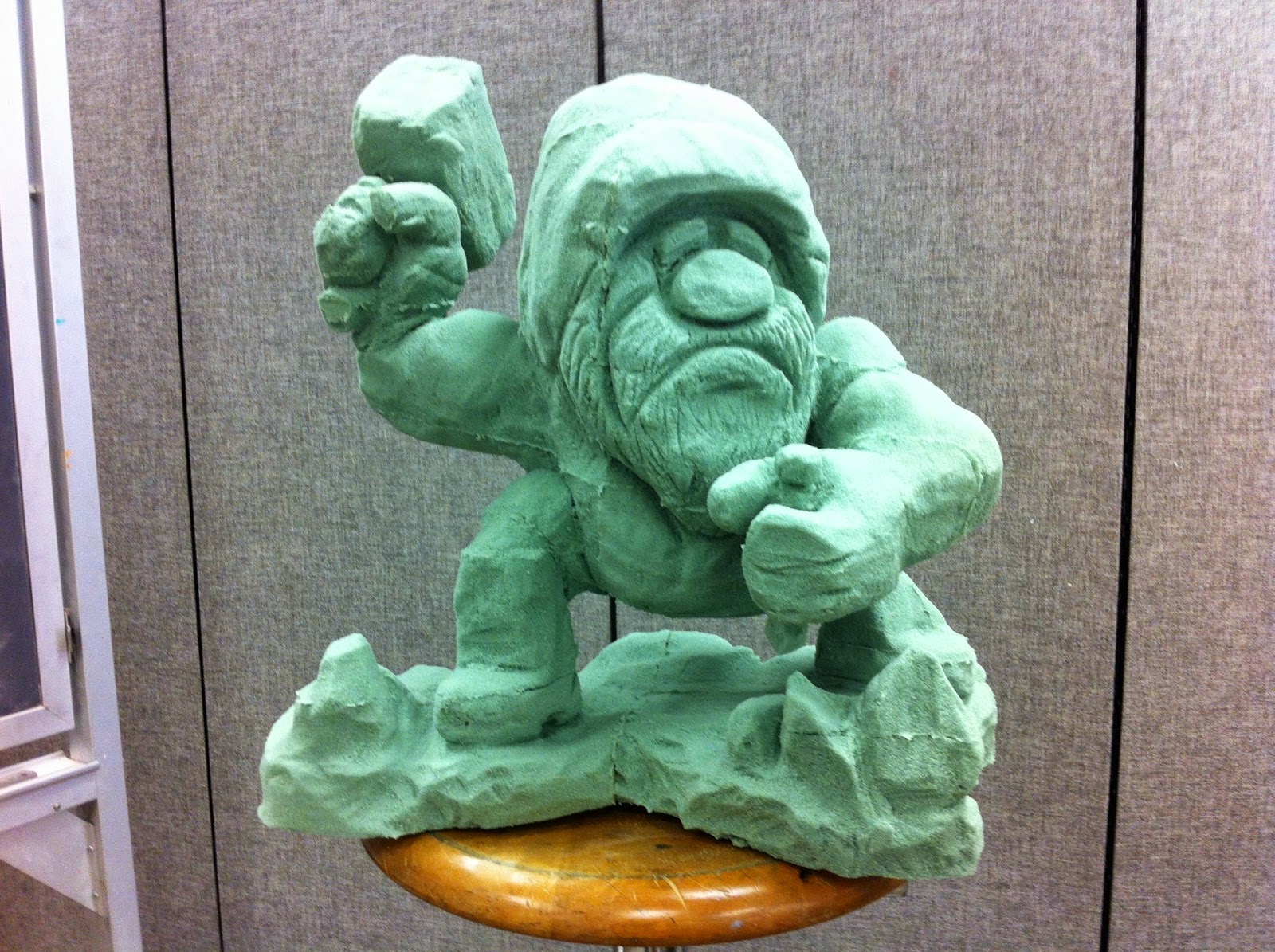
Over the years at A&M, I did a few sculptures in VIST 106 with Dick Davison. The two most notable ones were a subtractive sculpture made of florist foam and, of course, my robot sculpture:

While I've done a lot of practical, narrative, representative sculpture in the past, I'm interested in developing an interest in abstract forms in sculpture and developing higher mastery of materials.
I'm a senior Visualization student here at A&M. This is my last semester of undergraduate classes, and I hope to graduate in August and go straight into the MS-VIZ program from there.
ARTS 308 is my last directed elective, and I took it because I'm curious about what I can learn about physical sculpture, I want to develop more traditional art skills, the class fit my schedule well and I like the way Hwaryoung formats her classes.
Over the years at A&M, I did a few sculptures in VIST 106 with Dick Davison. The two most notable ones were a subtractive sculpture made of florist foam and, of course, my robot sculpture:
While I've done a lot of practical, narrative, representative sculpture in the past, I'm interested in developing an interest in abstract forms in sculpture and developing higher mastery of materials.
Subscribe to:
Posts (Atom)